
Sony didn't just build a good camera. It built a ladder — a single, matchable family that runs from a $1,600 Super35 body a solo creator can afford all the way up to the $54,000 full-frame cinema camera that shot F1: The Movie. Every rung speaks the same color language. That's the reason so many working filmmakers and hybrid shooters live entirely inside the Sony ecosystem — and it's also what makes choosing the right Sony genuinely confusing.
This guide fixes that. We shoot the Sony family every week at Caldera Films, and below is the honest, spec-grounded breakdown we wish existed when clients and crew ask us "which one should I buy?" — pulled together from the shooters and reviewers who actually put these bodies through their paces: CineD's lab tests, Philip Bloom, Gerald Undone, Newsshooter, Y.M.Cinema, DPReview and PetaPixel. No marketing gloss. Just what each camera is for.
There are two Sony families, and they solve different problems.
Cinema Line (the "FX" cameras and above) are video-first tools — built for rigging, long takes, and on-set cinema workflows. Most have no mechanical shutter and no EVF. Alpha (a7 / a1 / a9) are hybrid mirrorless bodies that shoot excellent video and real stills. If photography is half your job, you almost certainly want an Alpha. If you're shooting motion for a living, you want the FX line. Everything below flows from that split.
What "Cinema Line" Actually Means
Sony's Cinema Line is not a marketing sticker — it's a shared engineering philosophy. Every body in it, from the little FX30 to the VENICE 2, is built around the same color science and the same log workflow, so footage from a $1,600 camera intercuts cleanly with footage from a $50,000 one. For a multi-camera production, that is the whole ballgame. These are the features that unite the line:
- S-Cinetone — a ready-to-use, filmic color profile derived directly from VENICE color science. Pleasing skin tones and gentle highlight roll-off with no grading required.
- S-Log3 + S-Gamut3.Cine — the log/gamut container the entire family records into. One input transform is a common starting point across every body — the technical backbone of the "matchable look."
- Cine EI — a proper cinema exposure workflow that locks the sensor to its native base ISO and rates exposure via metadata, exactly like the high-end cameras.
- Dual base ISO — two true native sensitivities per sensor, each with its own clean noise floor.
- Active cooling, tally lamps, LUT import, and cage-free 1/4"-20 mounting — the practical hardware of shooting all day.
The single feature that divides the line — and the one buyers most often overlook — is the built-in variable ND filter. It lives only on the FX6, FX9, BURANO and VENICE. The compact bodies (FX30, FX2, FX3, FX5) and every Alpha have no internal ND, so you'll be running screw-in or matte-box filters. For run-and-gun work in changing light, that difference is bigger than any spec sheet suggests.
The Full Ladder: FX30 to VENICE 2
Here's the entire family in one view, cheapest to most expensive, so you can see where every camera sits before we go deep on each one. Prices are approximate US body-only figures as of mid-2026 — and worth noting, a tariff-driven US price wave in 2025–26 nudged several of these up, so confirm live before you buy.
Notice the low base ISO: it's 800 across almost the entire line — a deliberate workflow decision so your exposure discipline carries from an FX30 all the way to a VENICE. Now let's take each rung in turn.
At a Glance: The Complete Spec Comparison
Here's every camera side by side on the features that actually decide a purchase — sensor size, internal ND, IBIS, viewfinder, RAW and price. Notice the pattern in the compact bodies: it's ND or IBIS, rarely both. The FX3/FX30/FX2/FX5 give you in-body stabilization but no internal ND; the FX6/FX9 flip it. Only the BURANO gives you both. (Scroll the chart sideways to see every column.)
| Feature | FX30Super35 B&H ↗ |
FX2Full-Frame B&H ↗ |
FX3Full-Frame B&H ↗ |
FX5Full-Frame B&H ↗ |
FX6Full-Frame B&H ↗ |
FX96K FF B&H ↗ |
BURANOCineAltaB B&H ↗ |
VENICE 2CineAlta B&H ↗ |
|---|---|---|---|---|---|---|---|---|
| Sensor / Chip | 26MPSuper35 | 33MPFull-Frame | 12MPFull-Frame | 16.6MPFF · stacked | 10.2MPFull-Frame | 24.5MP6K FF | 8.6KFull-Frame | 8.6KFull-Frame |
| Base ISO(s) | 800/ 2,500 | 800/ 4,000 | 800/ 12,800 | 8004K · 12.8K | 800/ 12,800 | 800/ 4,000 | 800/ 3,200 | 800/ 3,200 |
| Max Video | 4K1201.6× crop | 4K60S35 crop | 4K120full-frame | 5K60OG · 4K120 | 4K120internal | 4K605K crop | 8.6K304K120 | 8.6K304K120 |
| Internal ND | – | – | – | – | ✓2–7 stops | ✓2–7 stops | ✓variable | ✓8-stop |
| IBIS | ✓ | ✓ | ✓ | ✓ | –gyro data | –gyro data | ★ND + IBIS | – |
| Built-in EVF | – | ✓tilting | – | –optional | – | – | – | – |
| RAW | External4.6K | Externalcrop | External4.2K | InternalX-OCN | ExternalSDI / BRAW | Externalvia XDCA | InternalX-OCN LT | InternalX-OCN |
| Price (body) | ~$1,600 | ~$2,700 | ~$3,900 | ~$4,900 | ~$6,000 | ~$11K | ~$25K | ~$54K |
| Feature | a7S IIIVideo-First B&H ↗ |
a7 V50/50 Hybrid B&H ↗ |
a7R VIStills-First B&H ↗ |
a1 IIFlagship B&H ↗ |
a9 IIIGlobal Shutter B&H ↗ |
a7C IICompact B&H ↗ |
|---|---|---|---|---|---|---|
| Sensor / Chip | 12MPFull-Frame |
33MPFF · stacked |
66.8MPFF · stacked |
50MPFF · stacked |
24.6MPFF · global |
33MPFull-Frame |
| Max Video | 4K12010-bit |
4K60full-frame |
8K304K120 |
8K304K120 |
4K120full-width |
4K60S35 crop |
| Rolling Shutter | ~8.7msminimal |
~14.5msgood |
~13.5ms8K · stacked |
lowstacked |
0msglobal |
moderate |
| IBIS | ✓ | ✓ | ✓ | ✓ | ✓ | ✓ |
| Internal ND | – | – | – | – | – | – |
| Built-in EVF | ✓9.44M | ✓ | ✓9.44M | ✓9.44M | ✓9.44M | ✓small |
| Price (body) | ~$3,500 |
~$2,900 |
~$4,500 |
~$7,000 |
~$6,000 |
~$2,200 |
The FX Cinema Line — Body by Body
This is the heart of Sony's appeal for working filmmakers: six bodies that share a look and a workflow, spanning a wide price range. Here's what each is genuinely for.
(APS-C, 1.5× crop)
Newsshooter nicknamed it "the baby FX3 with an APS-C sensor," and that's exactly right: identical body, fan, XLR handle and color science as the FX3, for less than half the money. It oversamples a 6K readout to a crisp 4K, and CineD found its dynamic range so close to the full-frame FX6 they couldn't reliably measure a difference. For anyone entering true cinema workflows, nothing else touches its value.
Announced May 2025, the FX2 is the newest and most interesting entry point to the full-frame Cinema Line — and it's not a de-tuned FX3. DPReview called it "the first hybrid camera to incorporate stills-oriented features into a video-oriented camera" — the reverse of the usual formula. Its headline trick is the first-ever tilting EVF on an FX body, plus a 33MP sensor that shoots genuine a7 IV-class stills and the best AI autofocus in the line.
The FX3 is the camera you see on gimbals, in cars, and in the hands of solo operators worldwide — and for good reason. Its low 12MP count gives it two superpowers: class-leading low light (that 12,800 high base is remarkably clean) and one of the fastest sensor readouts in the range, so rolling shutter is nearly a non-issue. Compact, full-frame, Netflix-approved, and refreshed as the FX3A in 2025. This is the modern indie-to-pro workhorse.
Announced July 2026, the FX5 is the most significant compact Cinema Line body Sony has made — it drops internal X-OCN RAW and 5K open-gate recording (VENICE/BURANO features) into a ~$4,900 body for the first time, with no external recorder needed for 16-bit RAW. Add a new triple base ISO (800/4,000/12,800), a fast stacked sensor, up to 16 stops of DR with Dual Gain, and the VENICE-style "BIG6" UI, and it reframes what a small Sony can do. CineD called it "finally, a compact camera worthy of the Cinema Line name." Read our full Sony FX5 review & specs →
The catch: the rumored global shutter didn't materialize (it's a fast-readout rolling shutter), and — surprisingly for a run-and-gun body — it has no built-in ND. It's also video-only (no stills mode), the EVF is an optional add-on, and a few top frame-rate modes arrive in a later firmware.
The FX6 is where you cross from "great camera" into "professional acquisition tool." It takes the FX3's low-light sensor and adds the things a working set demands: a built-in variable electronic ND (the feature that changes how you shoot in shifting light), 12G-SDI, timecode, and a body designed for a proper rig. Philip Bloom famously called it "a most confusing camera" and "the hardest camera review I have ever made" — because it's so capable it defies a single label. Its Fast Hybrid AF is so good reviewers say it focuses better than a manual operator.
One thing to know: the FX6 has no IBIS — it trades in-body stabilization for that internal ND (they compete for the same space behind the sensor), relying instead on gyro metadata you stabilize in post. And it's still current: rather than an "FX6 II," Sony's March 2026 firmware v6.0 brought the VENICE-style "BIG6" quick UI and Blackmagic RAW recording over HDMI to the existing body.
The top of the FX line and the traditional-bodied broadcast camera of the family. Its 6K full-frame sensor oversamples to a beautifully detailed 4K, and the shoulder-mountable body plus the XDCA extension unit make it the pick for long-form documentary, broadcast and ENG crews who need a real rig, robust build, and the full accessory ecosystem. Philip Bloom noted it fixed the two things he missed about the old FS7 — low light and autofocus.
"For a huge share of working shooters, the honest answer is an FX3 as your A-camera and an FX30 as a matched B-cam. Same body, same color, one full-frame low-light sensor and one affordable crop sensor — and everything intercuts."
— Caldera Films, on the most common real-world Sony kitThe High End: BURANO & VENICE 2
Above the FX line, Sony crosses a branding river into CineAlta — the digital cinema tier used on features and high-end episodic. Two cameras matter here, and they share the same remarkable 8.6K sensor.
(VENICE 2 sensor)
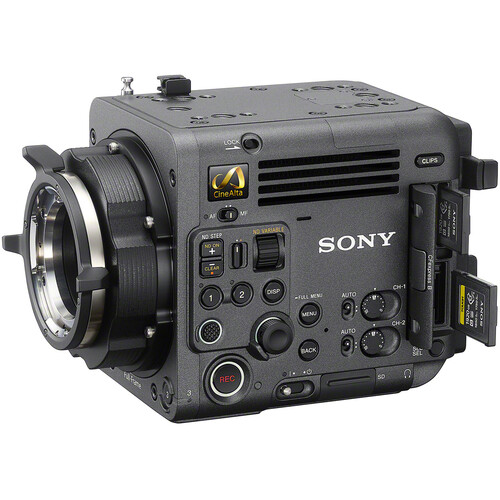
Sony branded it "CineAltaB" for a reason — the BURANO carries the same 8.6K sensor as the VENICE 2, and Sony says the two intercut with no perceivable difference. What makes it special is packaging that into a compact, self-contained body with IBIS, built-in electronic ND, and autofocus — a genuine one-operator cinema camera. Newsshooter frames it as the pick for "docs, corporate, music videos, wildlife" and as a popular B-cam alongside a VENICE 2.
The reference camera the entire line is built to match. VENICE is widely credited with flipping Sony's old "video-look, bad skin tones" reputation into a blockbuster staple — it shot Top Gun: Maverick, Avatar: The Way of Water, and most recently F1: The Movie. The VENICE 2 adds internal recording, an interchangeable sensor block (8.6K or 6K), the fastest full-frame readout CineD has ever tested, and the Rialto extension system for splitting the sensor off the body. Cinematographer Rob Hardy BSC ASC called moving to it "a no-brainer."
VENICE didn't shoot The Batman or Dune.
You'll see this claim online constantly — it's wrong. Those were shot on ARRI (Alexa LF / Mini LF and Alexa 65). And on the honest side of the ledger: while Sony's marketing cites 16 stops of dynamic range across the cinema bodies, independent CineD lab measurements consistently come in lower. Where ARRI still clearly leads is usable latitude and shadow cleanliness; where VENICE wins is full-frame 8K resolution, readout speed, built-in ND and modularity. Both are true. Trust exposure discipline over spec-sheet stop counts.
The Alpha Hybrids — Video and Photo in One Body
Here's the part that matters if you shoot stills for a living too. The FX Cinema Line bodies are video-first — most have no mechanical shutter and no EVF. The moment photography is a real part of your job, you want an Alpha. The good news: Sony's Alpha bodies now shoot video that holds its own against the cinema line, and they all speak S-Log3 and S-Cinetone, so they match the FX family in the grade.
This is the same imaging core Sony later put into the FX3 — identical picture. The difference is the body: the a7S III keeps a class-leading 9.44M-dot EVF and a mechanical shutter for stills, which the FX3 drops. It's the reference run-and-gun, documentary and event video body, with occasional stills capability.
Announced December 2025, the a7 V is the new default do-everything hybrid — and it fixes the two things everyone complained about on the beloved a7 IV: it shoots full-frame 4K60 with no crop (via 7K oversampling) and nearly halves the rolling shutter. Add 33MP stills, 30fps blackout-free shooting and the latest AI autofocus, and it's the body most working hybrid shooters should default to.
The resolution monster — now with the one thing the a7R line always lacked: speed. The a7R VI is the first R-series body with a stacked 66.8MP sensor, reading out roughly 5× faster than the a7R V. That finally tames the rolling shutter that plagued the older model, and unlocks 30fps bursts and 8K30. CineD measured the highest dynamic range they've ever tested (~14 stops); DPReview notes it "takes around 1/5th the time to read out 14-bit stills" as the V.
PetaPixel went further — "arguably the most impressive camera Sony has ever released," and "the last camera many photographers truly need." For landscape, studio, product and portrait work it's untouchable, and the video is now genuinely good rather than a compromise.
The camera that refuses to choose. 50MP stacked sensor, 8K video, 30fps stills and flagship autofocus in one body — DPReview calls it "the most accomplished and best-specced full-frame camera on the market." You pay dearly for it, but for a working pro who needs a single body to cover high-resolution stills and 8K motion, nothing else does it all this well.
The world's first full-frame global-shutter camera, and that's the whole story. For video it means the things that plague every other camera simply vanish: zero rolling shutter even on hard whip-pans, no banding or flicker under LED and artificial light, and flash sync at any speed. The trade is 24MP resolution and about a stop less dynamic range. A genuinely specialist tool.
Want the hybrid image in a smaller body? The a7C II.
The a7C II (~$2,199) puts the a7 IV's 33MP sensor plus a newer AI autofocus unit into Sony's smallest full-frame body. You trade the dual card slots, big EVF and AF joystick for genuine pocketability — DPReview summed it up as "small camera, little compromise." It's the true compact hybrid. Its sibling, the 61MP a7CR (~$2,999), is a compact stills monster, not a video tool.
The Two Debates Every Sony Buyer Has
The FX30 camp
Same body, same fan, same XLR handle, same color science — for ~$2,400 less. Slightly sharper oversampled 4K in good light, and cheaper APS-C glass. Y.M.Cinema: "superior value… comparable shooting capabilities." The smart default.
The FX3 camp
Two-plus stops more usable low light, the shallow full-frame look clients expect, and near-zero rolling shutter. When it's your A-cam and rent/resale and night shoots are on the line, it pays for itself.
As ShareGrid puts it: "If your work involves controlled studio lighting, the FX30 performs brilliantly; for those who work with available light, the FX3 remains the king." Buy the FX30 unless you specifically need low light or the full-frame aesthetic.
The FX3 adds
An active cooling fan (effectively unlimited recording), a detachable dual-XLR top handle with physical audio dials, tally lights, Cinema Line menus + Cine EI, and multiple 1/4"-20 mounting points. A video tool.
The a7S III has
What the FX3 gives up: a superb 9.44M-dot EVF and a mechanical shutter for stills — and it's about $400 cheaper. The better hybrid of the two.
The footage is identical — you're paying for the body, not a better picture (as Gerald Undone puts it). Video-first, long-take, pro-set shooters take the FX3; hybrid shooters who also want stills take the a7S III.
Which Sony Should You Buy?
Strip away the spec sheets and it comes down to the work you actually do. Here's the short version, by shooter profile.
Why It All Matters: One Look Across the Whole Kit
Here's the strategic point that a spec-by-spec comparison misses. The reason we build so many Caldera Films productions around the Sony family isn't any single camera — it's that they match. S-Cinetone is derived from VENICE color science. Every body records into the same S-Log3 / S-Gamut3.Cine container. So a multi-camera shoot can put a VENICE 2 on the A-cam, an FX6 on the gimbal, an FX3 in a tight space and an FX30 as a locked-off wide — and land all four in the same grade with one starting LUT.
That's a real production advantage: it lets budget dictate coverage instead of forcing a compromise on the look. One honest caveat the colorists we work with always flag — matching color is easy; matching character isn't automatic. Dynamic range, noise floor and rolling shutter differ by sensor, so exposure discipline across the kit is the load-bearing requirement. Nail that, and the Sony family behaves like one camera in seven sizes.
Whichever rung you're deciding between, the framework is the same: start from the work, not the spec sheet. Match the sensor size to your lighting reality, the body to your stills-vs-video split, and the price to how much the job actually pays. Do that, and there's a Sony that fits — which is exactly why the family has taken over so many working kits, ours included.